
Some paths to celebrancy arrive through a single moment of clarity. Lee Bond’s journey was, in his own words, more of a gentle unfolding. Shaped by a lifetime of spiritualist belief, a lifelong instinct to stand beside people in difficulty, and a calling to serve a community that gives everything and is too often left without support. As a spiritualist celebrant based in Stafford, Lee brings to this work things that can’t be taught – a pastoral heart, a poet’s gift for words, and a deep, abiding connection to those who serve in the armed forces. He trained with the Celebrant Coaching & Training Academy in both funeral and wedding celebrancy. This is his story.
“Trusting That Guidance Has Led Me to Places My Heart Needed to Be”
What was it that first made you think about becoming a celebrant?
My journey to becoming a celebrant wasn’t a straight line, it was more of a gentle unfolding. As a Spiritualist, I hold a deep belief that we remain connected to those we love, even after they’ve stepped beyond the veil. I’ve always felt guided by family, friends, and dear ones who now walk on the other side. Trusting that guidance has led me to places my heart needed to be. Even when I didn’t recognise it at the time.
That sense of connection has shaped so much of who I am. I’ve always felt a calling to support people, especially in moments of uncertainty or grief. Life gives each of us experiences, some bright, some difficult. I’ve come to understand that sharing the light we’ve gathered along the way can help others find their footing. Sometimes all someone needs is a steady presence, a listening ear, or a hand to hold while they look toward whatever lies ahead.
Becoming a celebrant felt like a natural extension of that calling. It allows me to stand with people at the most meaningful points in their lives. Honouring their stories, their emotions, and the people they love. It’s a role that blends compassion, creativity, and connection and it feels very much like where I’m meant to be.
“No Two Ceremonies Are Ever the Same, Because No Two Lives Are the Same”
You took both our funeral and wedding celebrant training. What was your favourite thing about each programme?
What I loved most about doing my two courses with Dinah was learning how to meet people exactly where they are. Whether they’re standing at the beginning of a shared life or facing the ache of saying goodbye. Both programmes taught me how to listen deeply. To understand what matters to someone, and to shape a ceremony that reflects their truth rather than a template.
The funeral training touched me in a very spiritual way. It taught me how to hold space for grief with gentleness. And how to honour a life in a way that feels authentic and compassionate. There’s something profoundly moving about helping families find meaning, comfort, and even moments of light as they say farewell. I felt guided throughout by my own beliefs, by the sense of connection I have with those beyond the veil. And by the responsibility of doing justice to someone’s story.
The wedding training brought a different kind of spirituality
One rooted in joy, hope, and the weaving together of two paths. I loved learning how to create ceremonies that feel personal and heartfelt. Where every word and gesture reflects the couple’s journey. There’s a beautiful energy in helping people mark the start of something new. I found real fulfilment in learning how to shape that moment with intention and creativity.
Across both courses, what stood out most was discovering just how unique each person’s wishes are. No two ceremonies are ever the same, because no two lives are the same. I loved learning how to craft bespoke ceremonies that carry meaning. Ceremonies that feel like they belong to the people at their centre, not borrowed from someone else’s script.
Both courses deepened my belief that a ceremony is a form of connection, to each other, to our stories, and to something greater than ourselves. And that’s what I’m most grateful to have learned.
A Life Spent Listening to What Sits Beneath the Words
What key skills do you think you bring to the role, that you’ve gained from your career to date and or life experience?
I think the key skills I bring to the role come from a blend of my life experience, my spiritual beliefs, and the way I naturally connect with people. At the heart of it, I’ve always been someone who listens not just to words, but to what sits beneath them. My Spiritualist beliefs have taught me to pay attention to the quiet spaces. The intuition, the sense of guidance that comes when you’re truly present with someone. That ability to tune in, to meet people gently where they are, feels essential in celebrancy work.
My life has given me moments of joy, challenge, loss, and renewal. And I’ve learned that these experiences become tools, ways of understanding others. Ways of offering comfort or clarity when someone needs it. I’ve walked a few winding paths, and I think that helps me stand alongside people on theirs with empathy rather than assumption.
“Poetry Lets Me Honour the Moment in a Way That Feels Personal and Meaningful”
You have a love of poetry and a talent for creating your own. How are you hoping to bring this to your work as a celebrant?
Creatively, poetry has shaped me more than anything. Writing bespoke poetry for ceremonies allows me to express what people feel but can’t always articulate. It’s a skill I treasure, the ability to take someone’s story, their memories, their hopes, and weave them into words that feel like a gift back to them. Whether it’s a wedding full of light or a funeral held in quiet reflection, poetry lets me honour the moment in a way that feels personal and meaningful.
I also bring a calmness and steadiness from my professional background. The ability to handle detail, responsibility, and sensitive situations with care. But more than that, I bring a genuine love of people. I enjoy learning about their lives, their quirks, their wishes, and the things that matter most to them. No two ceremonies are ever the same. I find real fulfilment in crafting something bespoke that reflects who they are.
All of these threads the spiritual, the creative, the personal come together in celebrancy. They help me to start creating ceremonies that feel heartfelt, grounded, and truly connected to the people at their centre.

“To All of Them, I Am Simply Padre”
You’re part of a re-enactment group, can you tell us about this and how you’re hoping to bring your celebrant work into this?
Being part of the Warwick’s 1914/1918 Living History Group is one of the most meaningful things I do. It holds a very special place in my heart. I serve as the regiment’s padre, a role I take seriously and feel genuinely called to. The group is made up largely of serving members of His Majesty’s Armed Forces. Many receive special dispensation from their regiments to take part in the remembrance and portrayal of the Warwickshire Regiment of the Great War. Alongside them are veterans who bring their own depth of experience and camaraderie. To all of them, I am simply “Padre,” and I’m honoured to be seen that way.
My duties within the group are spiritual, emotional, and pastoral. Supporting the lads in good times and in difficult ones, and this carries over into lives away from the reenactment circuit. Over the years, some have come to me during moments of loss or struggle, and I’ve felt deeply moved that they’ve trusted me enough to reach out. I look after them as any padre would look after his flock, offering a steady presence, a listening ear, and whatever guidance I can give. It’s a responsibility I hold with real reverence.
My celebrancy work has already woven itself naturally into this part of my life.
The skills I’ve learned holding space, offering comfort, creating and giving meaningful words for moments of both sorrow and joy have helped me support the lads in ways that not only feel but are truly authentic and grounded. Whether it’s helping someone navigate grief or celebrating a moment of happiness, the heart of celebrancy fits perfectly with the heart of being a padre.
I once tried to apply to serve formally as a military chaplain, but I was told I was now too old to join, even within the reserves. That was difficult to hear, but it also clarified something for me, celebrancy is the path that allows me to continue doing the work I feel called to. It lets me stand beside those who serve, honour their stories, and offer the kind of support that feels spiritually meaningful.
In many ways, celebrancy is simply an extension of what I already do within the regiment a way to bring compassion, connection, and purpose into a community I care deeply about.
“If I Can Be Even a Small Glimmer of Light for Someone Walking a Difficult Path”
You’ve shared with me that you want to work with people from the armed services, can you tell us why this matters to you?
Working with people from the armed services matters to me in a way that’s hard to put into simple words it feels like both a calling and a responsibility. Through my role as padre with the Warwick’s I’ve seen firsthand the weight that serving personnel carry. They give everything, their time, their strength, their safety, and often parts of themselves that the rest of society never sees. They stand between us and danger so that we can live ordinary lives in peace. I’ve always felt that if someone gives that much, the least we can do is give something meaningful back.
What troubles me deeply is how many of them feel abandoned once their service ends. For years, sometimes decades, they’ve lived in a world of structure, purpose, and brotherhood and then they’re expected to step back into what we call “normal society” without the support they deserve. That transition can be incredibly hard, and for some, it leads to very dark places. I’ve walked alongside lads who’ve struggled, and I’ve held space for them in moments when they felt lost. Those experiences stay with you.
If I can be even a small glimmer of light for someone walking a difficult path, a steady presence, a listening ear, a voice that reminds them they’re not alone then that feels like a life well spent as a celebrant. Celebrancy gives me a way to do that with purpose. It allows me to honour their stories, support them spiritually and emotionally, and create ceremonies that recognise their service, their sacrifices, and their humanity.
For me, working with the armed forces isn’t just an area of interest it’s part of who I am. It’s where my heart feels most at home, and where I believe I can do the most good.
“One of the Best Things in the Whole Wide World”
What types of ceremony are you most looking forward to creating?
I’m especially looking forward to creating wedding and naming ceremonies, because they carry such a beautiful sense of joy and new beginnings. There’s something profoundly moving about helping couples and families mark a moment that will travel with them for the rest of their lives. A wedding day or a naming ceremony becomes part of someone’s story a memory they’ll carry forward, and one their guests will hold onto as well, something I call a forever memory. To be trusted with shaping that moment feels like a real gift.
What excites me most is the chance to create ceremonies that are truly bespoke, full of heart, and centred on love in all its forms. Celebrating joy, life, and connection is one of the greatest privileges of being a celebrant, and I can’t think of anything more meaningful than helping people begin a new chapter wrapped in words that feel like theirs, its one of the best things in the whole wide world.
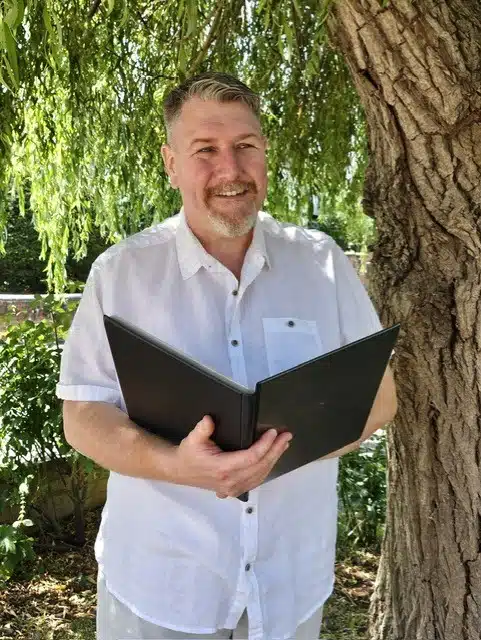
Five Things About Lee the Person
Poetry is at the heart of who I am. Writing gives me a way to express emotion, connection, and meaning in a way nothing else quite can. Words are powerful they can comfort, inspire, and carry love across centuries. The idea that something I write might be read long after I’m gone, that a poem could become part of someone’s story, means the world to me. Wordsmithing feels like a gift we’re meant to share.
I’m passionate about supporting our farmers. Living rurally, surrounded by beautiful countryside, I see every day how much farmers give and how little recognition they receive. They are custodians of the land that feeds us, often working quietly and tirelessly behind the scenes. I believe deeply in standing up for them, honouring their work, and ensuring they are supported just as they support all of us.
I love gardening and being outdoors, especially with my grandchildren. Some of my happiest moments are spent showing them roses, insects, and the small wonders of the garden. They’re still so young, but those shared discoveries feel golden. Family means everything to me and being present for the smallest members of my clan teaching them, laughing with them, watching them grow is one of life’s greatest joys.
Creativity runs through my hobbies, especially miniature painting
I’m part of a local wargaming community that offers friendship, purpose, and connection to people who sometimes don’t have much else in their week. Painting miniatures and building worlds together is more than a pastime it’s a way of belonging, of supporting others, and of creating something meaningful as a group.
I value life in all its forms, and I love spending time simply observing the world around me. One of my favourite things to do is take a quiet moment outdoors watching the birds, noticing how the light falls across the fields, or just feeling part of the rhythm of nature. I’ve always believed that everything is connected, every living thing woven into a vast and beautiful tapestry. Taking time to appreciate that, to show gratitude for the world we’re part of, keeps me grounded and reminds me how precious life is. It’s a simple thing, but it brings me a lot of peace.
A Note from Dinah
Lee came to training with something that can’t be taught – a lifetime of showing up for people in their most vulnerable moments. As his trainer, watching him bring together his spiritualist beliefs, his poetry, his pastoral heart, and his deep commitment to the armed forces community was one of the privileges of this work. Lee is still very much woven into the lives of the servicemen and veterans he serves so faithfully in Staffordshire. I have no doubt that every ceremony he creates will carry something of that rare and extraordinary spirit.
If Lee’s story has resonated with you, and you’re wondering whether celebrancy might be your next chapter, I’d love to have that conversation with you. Book an Informed Decision Session and let’s find out what kind of celebrant you might become.
Dinah (She/Her)